Conservation Laws for Diffusion Models
TLDR. For memoryless noise processes, marginal posteriors along the noise path characterize the likelihood of the underlying data distribution. The channel type is therefore a design variable that is theoretically likelihood-invariant, but finite-capacity denoisers make this choice matter in practice.
Cross-Entropy Conservation Law
Using the notation below, the main theorem of the paper states that the data-model cross-entropy is conserved as an area along any memoryless noising path from clean data to pure noise.
| Notation | Meaning |
|---|---|
| \(P_X\) | Data distribution over clean sequences \(X=(X_1,\ldots,X_n)\). |
| \(Q_X\) | Model-induced distribution whose cross-entropy against \(P_X\) is evaluated. |
| \(Y(\mathbf t)\) | Noised observation generated by applying coordinate-wise noise levels \(\mathbf t=(t_1,\ldots,t_n)\). |
| \(W_{t_i}(y_i\mid x_i)\) | Known memoryless forward channel for coordinate \(i\). |
| \(\gamma(\tau)\) | Path through noise-parameter space from clean data to pure noise. |
| \(\gamma_i^\prime(\tau)\) | Speed of the path in coordinate \(i\), weighting that coordinate's local derivative. |
| \(Q_{X_i\mid Y}\) | Model marginal posterior used to evaluate the local derivative. |
| \(S_t(x,y)\) | Channel score \(\partial_t\log W_t(y\mid x)\). |
General CE identity
The theorem writes cross-entropy as the path integral of local CE derivatives.
\[ \operatorname{CE}(P_X,Q_X) = \int_0^1 \sum_{i=1}^n \gamma_i^\prime(\tau) \frac{\partial}{\partial t_i} \operatorname{CE}\!\left( P_{X_i\mid Y(\mathbf t)}, Q_{X_i\mid Y(\mathbf t)} \right) \Big|_{\mathbf t=\gamma(\tau)} d\tau . \]Score-likelihood derivative
The local derivative is evaluated from marginal posteriors and the channel score.
\[ \begin{gathered} S_t(x,y)=\partial_t\log W_t(y\mid x),\\[0.35em] \frac{\partial}{\partial t_i} \operatorname{CE}\!\left(P_{X_i\mid Y},Q_{X_i\mid Y}\right) = \mathbb E_P\!\left[ -S_{t_i}(X_i,Y_i)\log Q_{X_i\mid Y}(X_i\mid Y) + \mathbb E_{X'\sim Q_{X_i\mid Y}(\cdot\mid Y)} \!\left[S_{t_i}(X',Y_i)\mid Y\right] \right]. \end{gathered} \]Markov Ground-Truth Validation
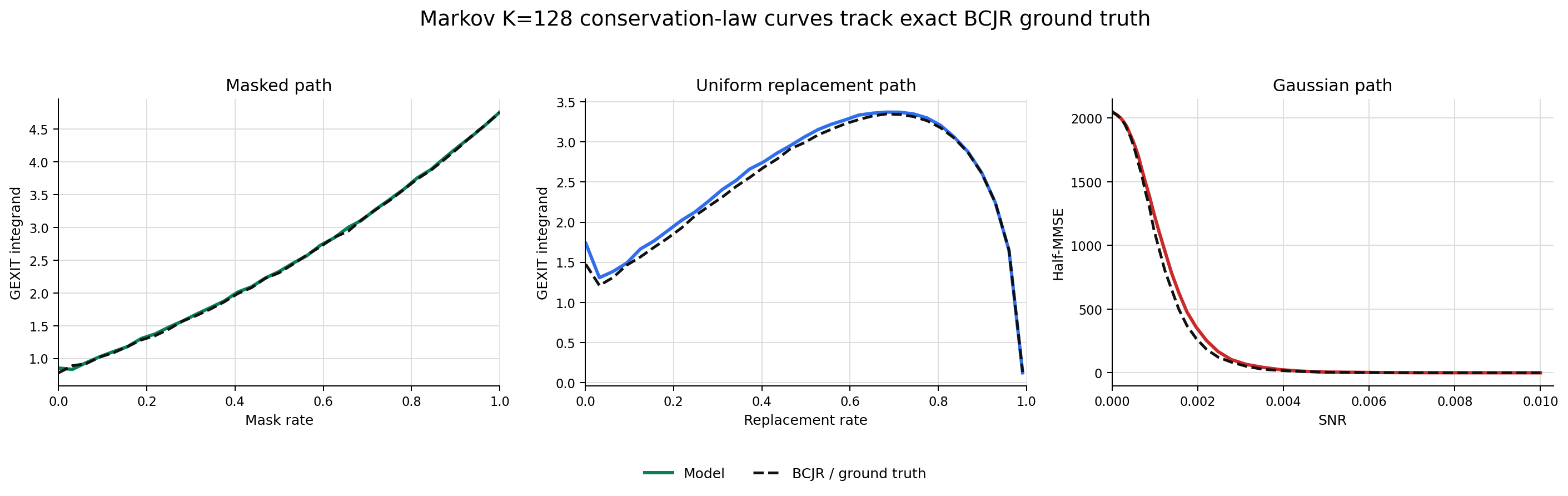
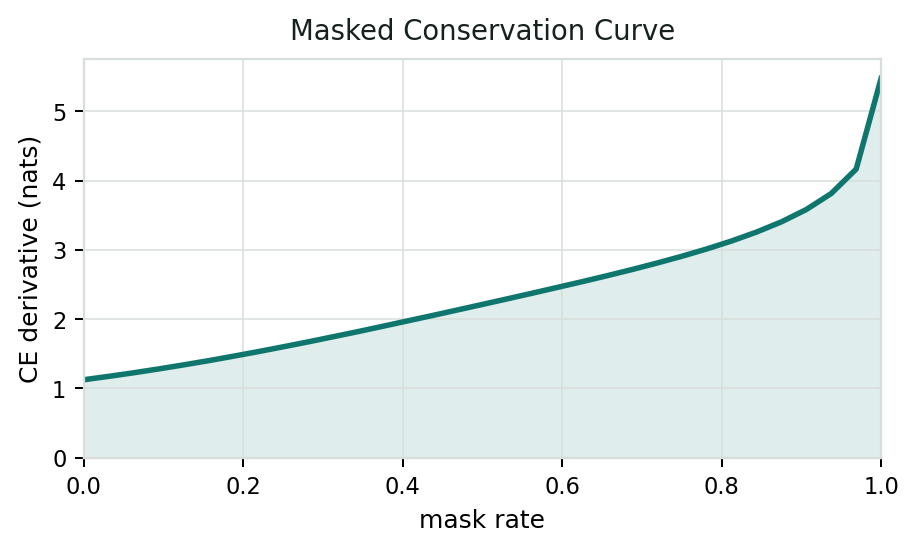
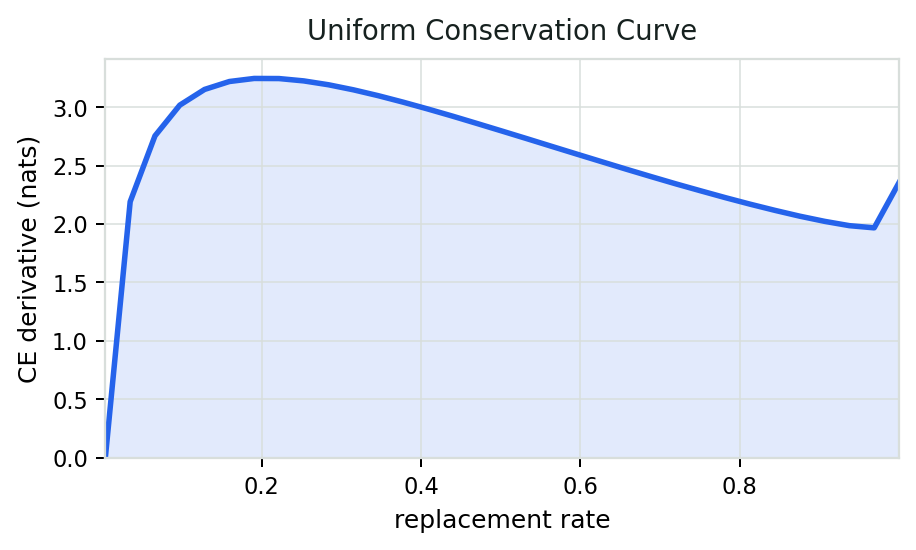
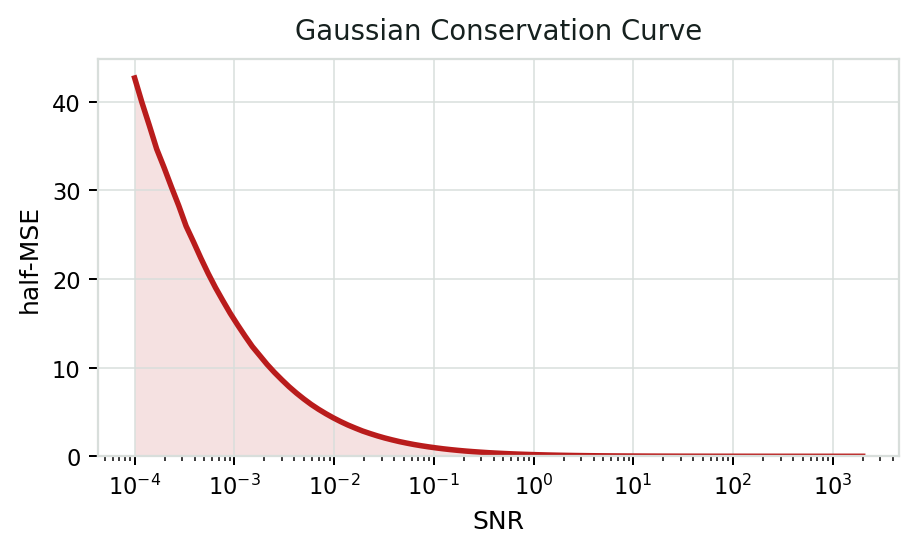
For synthetic Markov sources, the BCJR algorithm gives exact conservation-law integrands. The solid model curves track the dashed ground-truth curves for masked, uniform replacement, and Gaussian noise paths at alphabet size 128.
| Method | Area (nats) | Rel. error |
|---|---|---|
| EXIT | 2.484 | 1.24% |
| QSC | 2.520 | 2.74% |
| I-MMSE | 2.701 | 10.09% |
text8 Results
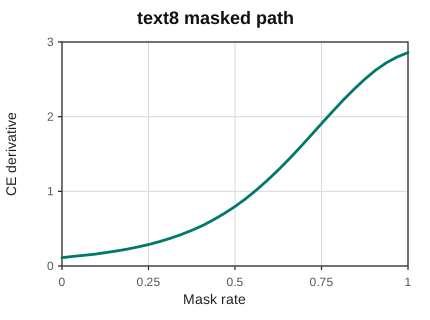
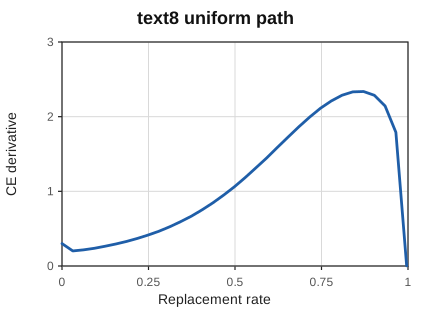
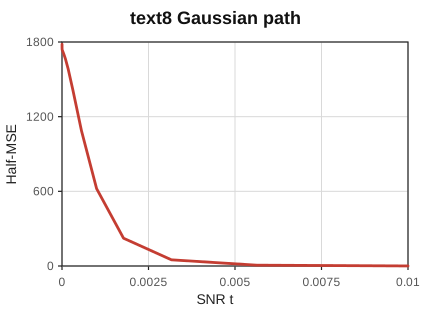
The language-model experiments evaluate byte-level text8 without external data. Results are reported in bits per character; lower is better.
| Model | External data | BPC |
|---|---|---|
| Our methods | ||
| masked (ours) | No | 1.424 |
| uniform (ours) | No | 1.513 |
| Gaussian (ours) | No | 2.087 |
| Reference methods | ||
| D3PM mask/absorbing | No | ≤ 1.45 ± 0.02 |
| SEDD Absorb | No | ≤ 1.39 |
| MDLM | Yes | ≤ 1.40 |
| MD4 | Yes | ≤ 1.37 |
| EDLM | Yes | ≤ 1.24 |
CIFAR-10 Results
The image-token experiments use the same conservation-law viewpoint on CIFAR-10 RGB8 tokens. The tables reproduce the NeurIPS sample-quality and likelihood comparisons.
Conservation Curves
Sample Quality
| Noise | Schedule | FID | IS |
|---|---|---|---|
| Our methods | |||
| uniform (ours) | cosine | 59.5084 | 6.21 ± 0.06 |
| masked (ours) | equal-info | 30.69 | 6.87 ± 0.08 |
| Gaussian (ours) | log-uniform | 26.66 | 7.338 ± 0.080 |
| Reference methods | |||
| D3PM uniform | cosine | 51.27 ± 2.15 | 5.99 ± 0.14 |
| D3PM absorbing | mutual-info | 41.28 ± 0.65 | 6.26 ± 0.10 |
| D3PM Gauss + logistic | linear | 7.34 ± 0.19 | 8.56 ± 0.10 |
| DDPM | linear-beta | 3.17 | 9.46 |
| Score SDE | geometric-sigma | 2.20 | 9.89 |
Likelihood
| Model | BPD |
|---|---|
| Reference methods | |
| DDPM | ≤ 3.70 |
| Improved DDPM | ≤ 3.40 |
| Score SDE | ≤ 2.99 |
| ML Score SDE | ≤ 2.99 |
| D3PM Gauss + logistic | ≤ 3.435 ± 0.007 |
| Our methods | |
| uniform | 3.66 |
| masked | 3.31 |
| Gaussian | 3.24 |
Image Generations
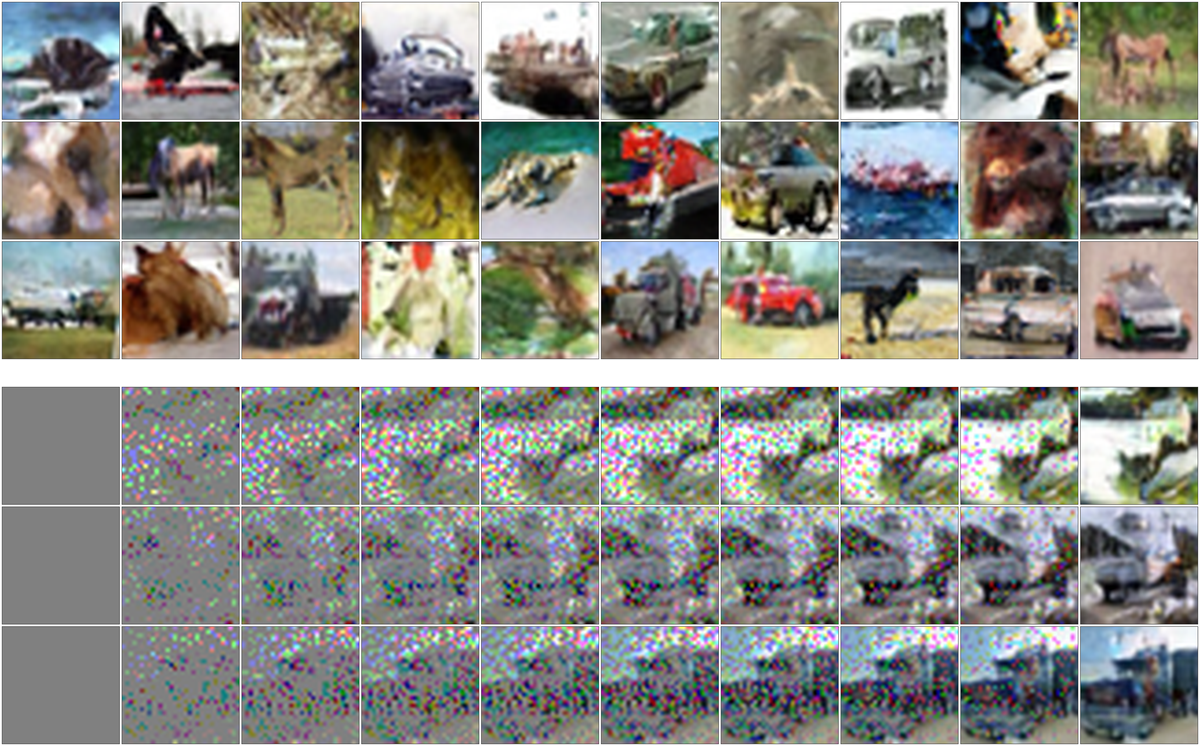
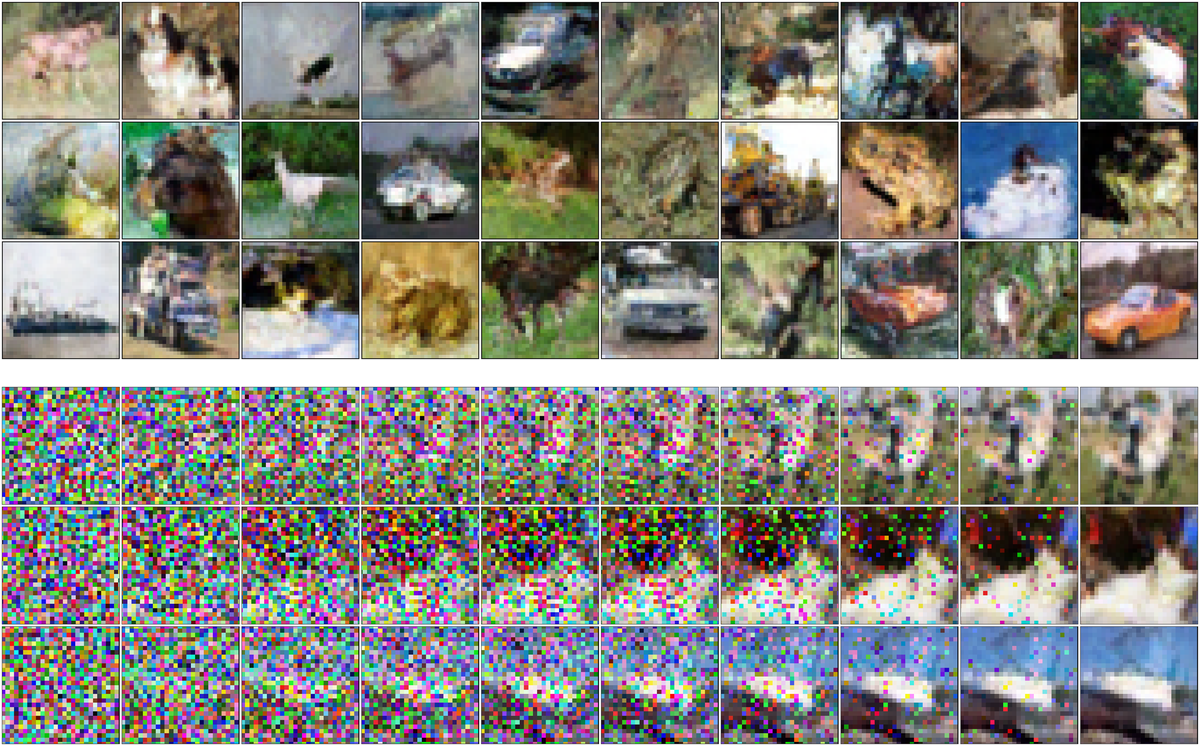
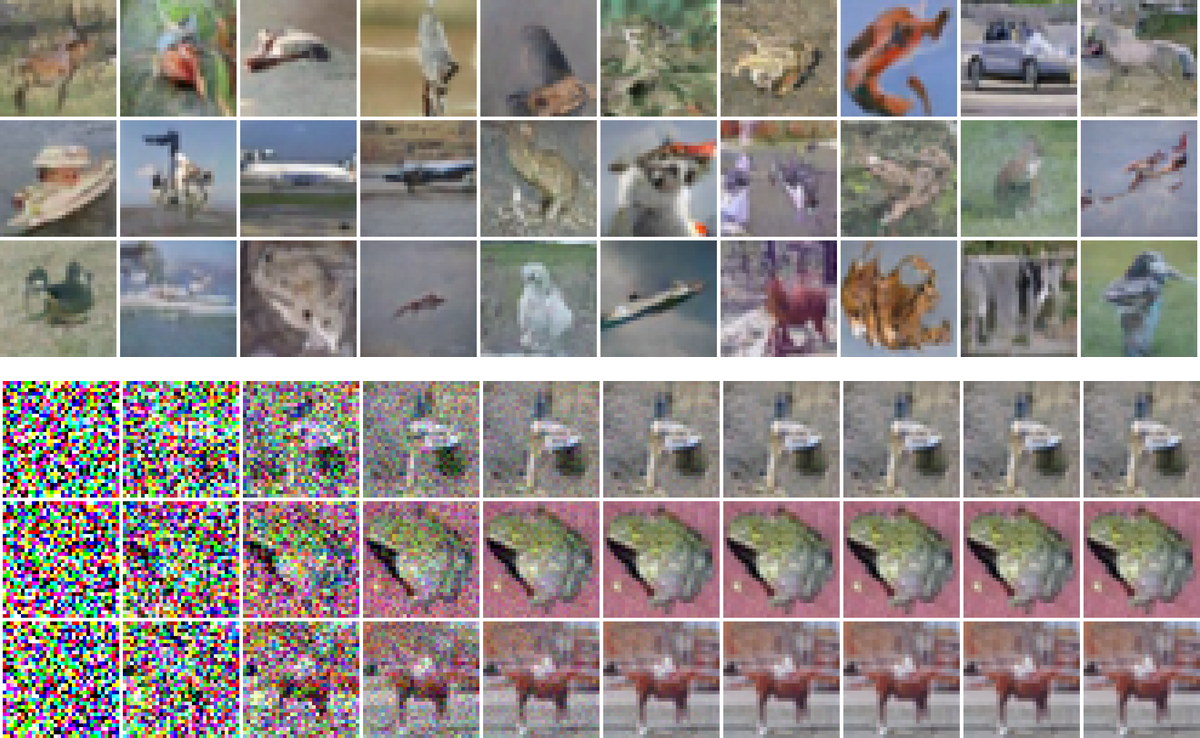
CIFAR-10 RGB8 samples generated with the masked, uniform, and Gaussian noise paths, with representative diffusion traces shown below each sample panel.
Citation
@misc{aharoni2026conservation,
  title = {Conservation Laws for Diffusion Models},
  author = {Ziv Aharoni and Henry D. Pfister},
  year = {2026},
  note = {arXiv identifier forthcoming},
  url = {https://zivaharoni.github.io/conservation-laws-diffusion-models/}
}
Replace the arXiv placeholder link and citation note after the paper is posted.